

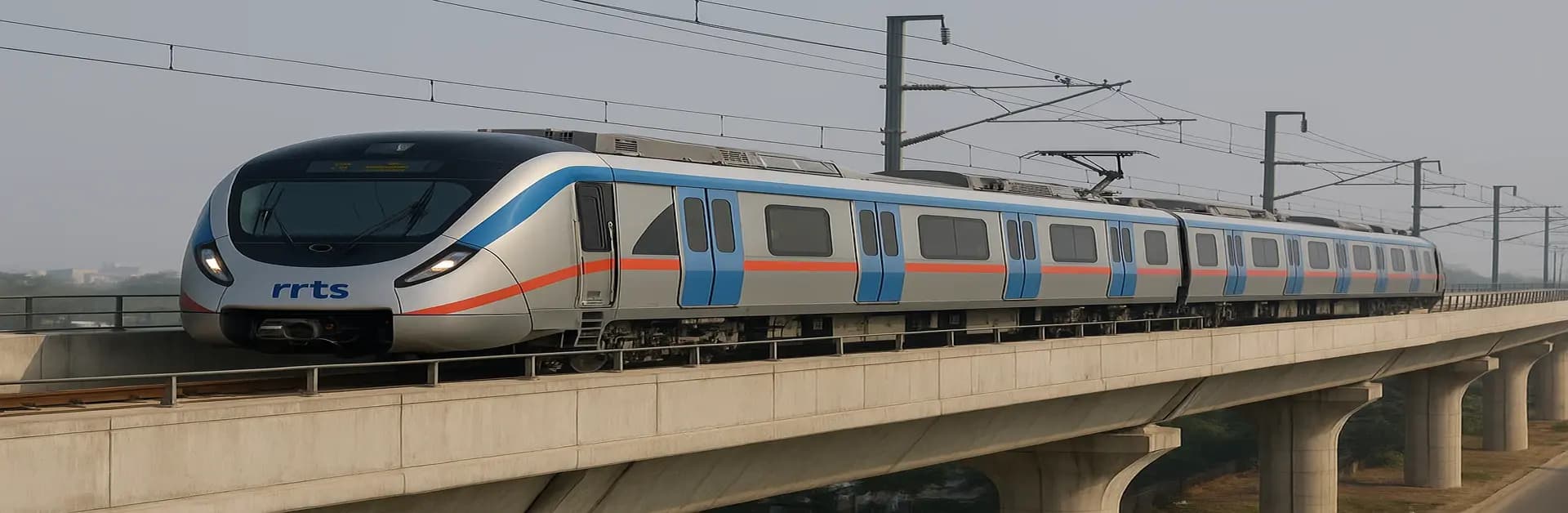
Proposed RRTS Route from Ghaziabad to Jewar Airport
Contents
- Ghaziabad-Jewar RRTS
- Key Facts About Ghaziabad-Jewar RRTS
- Phases of the Corridor
- Phase 1: Ghaziabad to Greater Noida
- Phase 2: Greater Noida to Jewar Airport
- Ghaziabad-Jewar RRTS Route Map
- Ghaziabad-Jewar RRTS - Further Plans
- Proposed Metro Stop Near Jewar Airport
- Type of Metro Service at Jewar Airport
- The Final Word
The rapid urbanisation of the Delhi-NCR region has highlighted the urgent need for fast and efficient transport. With Noida International Airport (Jewar Airport) emerging as a key infrastructural milestone, seamless connectivity from major cities like Ghaziabad is a priority. That’s where the Ghaziabad-Jewar RRTS comes in, a proposed high-speed transit corridor that promises to drastically cut travel time and ease congestion for daily commuters, business travellers, and airport passengers alike.
Ghaziabad-Jewar RRTS
The Ghaziabad-Jewar RRTS (Regional Rapid Transit System) is a game-changing initiative under the broader RRTS network planned for the National Capital Region. Designed to offer high-speed rail connectivity between Ghaziabad and the upcoming Jewar Airport, this corridor is expected to play a significant role in shaping the region’s mobility future. With trains capable of running at speeds up to 160 km/h, this route will significantly reduce the travel burden on existing roads and highways.
The idea is not just to connect two points but to integrate key economic zones and urban clusters along the Ghaziabad-Jewar RRTS route, supporting both commuter convenience and regional development.
Key Facts About Ghaziabad-Jewar RRTS
- Route Length: Expected to cover approximately 80–90 kilometres, depending on the final alignment.
- Top Speed: Trains may run up to 160 km/h, making it one of the fastest suburban travel options in the region.
- Operator: The National Capital Region Transport Corporation (NCRTC) is likely to oversee operations.
- Connectivity: Will link major NCR nodes, including Ghaziabad, Greater Noida, and Jewar Airport.
- Estimated Time Saving: Travel time could come down from 2.5 hours to under 60 minutes.
- Intermodal Integration: Plans are in place to connect it with other RRTS lines, metro systems, and expressways.
Phases of the Corridor
The project is expected to unfold in two main phases, focusing first on essential urban links before extending to regional and airport connectivity.
Phase 1: Ghaziabad to Greater Noida
In this initial phase, the RRTS corridor will run from Ghaziabad through Greater Noida, covering densely populated urban zones. This section is critical as it will cater to thousands of daily commuters travelling between commercial and residential hubs. It will also serve as a feeder line for those heading to Jewar Airport in the future.
Phase 2: Greater Noida to Jewar Airport
The second phase will stretch from Greater Noida to Noida International Airport (Jewar Airport). This extension is designed to provide last-mile, high-speed connectivity for air passengers, particularly those coming from eastern NCR and Uttar Pradesh. With this phase, the Ghaziabad-Jewar RRTS route becomes an essential airport transit link, similar to global standards in urban-airport mobility.
Ghaziabad-Jewar RRTS Route Map
Although the final alignment is still under review, early reports suggest that the Ghaziabad-Jewar RRTS route will pass through the following key locations:
- Ghaziabad
- Sahibabad
- Sector 62 Noida
- Greater Noida West
- Pari Chowk
- Yamuna Expressway sector
- Noida International Airport (Jewar)
Strategic station placements along this route aim to balance commuter accessibility with travel speed. The route is expected to run either on elevated tracks or at-grade, depending on the terrain and urban density.
Ghaziabad-Jewar RRTS - Further Plans
Beyond just connecting the airport, the Ghaziabad-Jewar RRTS may see further extensions in the future. Urban planners are considering possibilities of extending the corridor westward to Meerut or linking it with the Delhi-Meerut RRTS. There are also discussions about creating multi-modal hubs along the corridor to support freight logistics, park-and-ride facilities, and metro-bus transfers.
This foresight ensures that the Ghaziabad-Jewar RRTS route is not just a project for today but a scalable solution for tomorrow’s urban transport challenges.
Proposed Metro Stop Near Jewar Airport
As part of the regional transport ecosystem, a dedicated metro stop near Jewar Airport has also been proposed. This metro station will complement the RRTS system by offering more granular, city-level connectivity. Travellers who arrive via the RRTS can transfer smoothly to the metro network, reaching areas not directly served by rapid rail.
This kind of integrated infrastructure is crucial for an airport expected to serve millions annually once fully operational.
Type of Metro Service at Jewar Airport
The metro service planned for Jewar Airport is expected to be a high-capacity, standard-gauge rapid metro, possibly an extension of Noida Metro’s Aqua Line or a completely new corridor. The aim is to offer seamless, end-to-end urban mobility with minimal transfers. It will cater to both daily commuters in Greater Noida and international travellers using GIFT International Financial Services Centre and Jewar Airport as gateways.
The Final Word
The Ghaziabad-Jewar RRTS is more than a rail project, it’s a vision for faster, smarter, and more connected living in the NCR. With modern infrastructure, reduced travel times, and airport-grade efficiency, this corridor is poised to reshape the way we think about commuting and regional integration.