

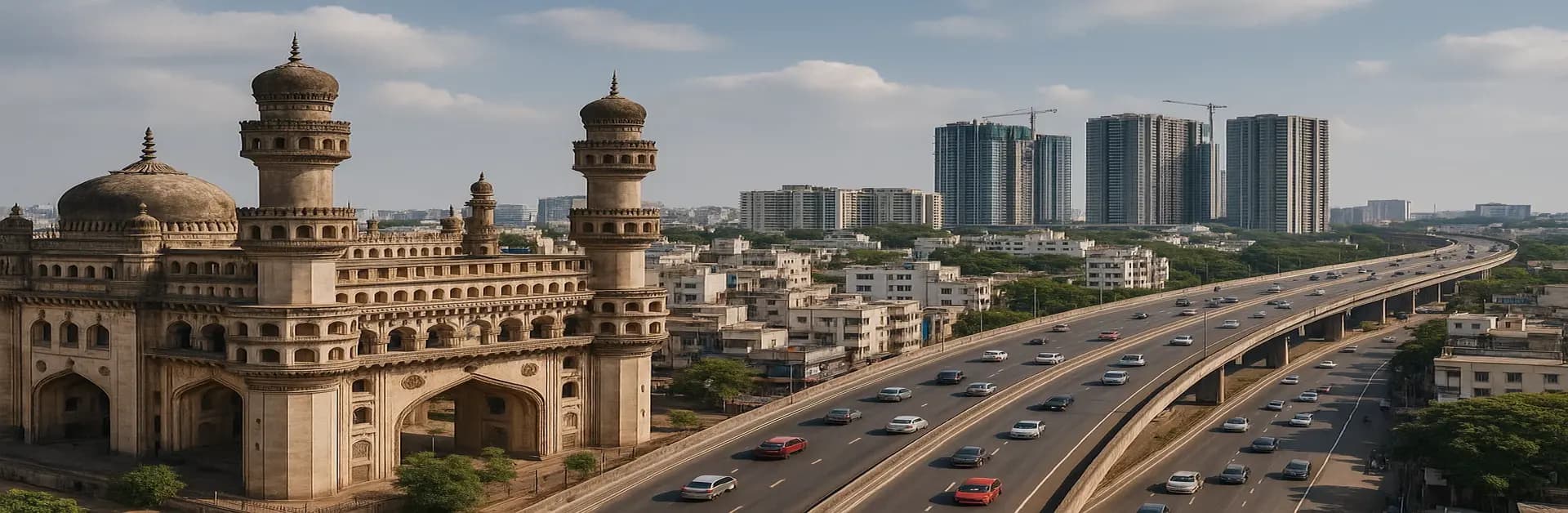
H-CITI: The Future of Hyderabad’s Urban Transformation
Contents
Hyderabad, one of India’s most vibrant tech and cultural hubs, is gearing up for a massive leap into the future with the Hyderabad City Innovative and Transformative Infrastructure (H-CITI) Programme. Spearheaded by GHMC (Greater Hyderabad Municipal Corporation), this ambitious plan aims to reimagine urban life in Hyderabad city by introducing world-class infrastructure, smarter connectivity, and sustainable solutions. It’s not just about building roads or laying pipelines, it’s about preparing the city for the next two decades and beyond.
Goals for Urban Transformation and Innovation
At the heart of the H-CITI Programme lies a clear vision: to make Hyderabad a more liveable, efficient, and future-ready city. The key goals include easing congestion, improving mobility, ensuring sustainable urban development, and promoting innovation in public infrastructure. Whether it’s through smart traffic systems, upgraded sewage management, or digital governance tools, GHMC plans to touch nearly every aspect of urban life. It’s also about making Hyderabad more inclusive, better roads and services for all, from central neighbourhoods to expanding outskirts.
Initial Phase and Key Projects Under H-CITI
The first phase of the H-CITI Programme has already been set in motion, with a budget crossing INR 2,000 crore. The focus initially is on low-hanging yet impactful projects, like widening arterial roads, fixing bottlenecks in the city’s stormwater drain system, and constructing new flyovers and underpasses to reduce commuting time. GHMC has taken charge of several multi-corridor development projects, especially in high-traffic zones such as Kukatpally, LB Nagar, and Uppal.
Another big-ticket item under this phase is the construction of modern footpaths, integrated with cycling tracks and green belts. These aren’t just urban niceties, they’re a push toward making Hyderabad a walking- and cycling-friendly city, reducing dependence on cars and pollution in the long run.
Essential Infrastructure Upgrades in Hyderabad’s H-CITI Programme
Infrastructure forms the backbone of the Hyderabad City Innovative and Transformative Infrastructure (H-CITI) Programme. GHMC has prioritised areas that have long been neglected, revamping drainage systems to tackle urban flooding, replacing old pipelines, strengthening sewage networks, and ensuring uninterrupted power and water supply in key residential and industrial pockets.
One standout initiative is the installation of a smart water grid system across several localities in Hyderabad city. This tech-enabled system will help monitor leakages, optimise usage, and improve delivery efficiency. Simultaneously, overhead electrical cabling is slowly being shifted underground, a move that’s both aesthetic and practical, especially during monsoons.
Read More About: Transforming Hyderabad: The Impact of Upcoming Infrastructure Projects
Transportation Connectivity and Roadway Expansion
One of the core challenges Hyderabad city faces is traffic. The H-CITI Programme squarely addresses this with a multi-pronged approach. Major roadways are being widened, new link roads are being carved out, and traffic signals are being synchronised via a central control room.
Flyovers at strategic junctions, such as at Balanagar, Mehdipatnam, and Ameerpet, are either underway or in planning. GHMC’s long-term aim is to create a web of connected corridors that allow smooth East-West and North-South travel within the city. A push is also being made to integrate various modes of transport, like buses, metro rail, and last-mile autos or e-rickshaws, into a more seamless urban commute.
A Vision for Hyderabad’s Transformation
Beyond just civil works, the H-CITI Programme is about creating a city that’s resilient and responsive. GHMC envisions Hyderabad as a “15-minute city”, where access to essential services like schools, clinics, and groceries is possible within a 15-minute walk or cycle ride from home.
Public spaces are being rethought, with parks getting digital upgrades, community halls being constructed with solar roofing, and public toilets designed with smart sensor systems. The city is also investing in green urbanism, planting lakhs of trees along highways, creating new lung spaces, and encouraging rooftop solar installations. This is not just modernisation; it's transformation with a conscience.
The H-CITI Programme is not just another city beautification drive; it’s a holistic vision for what Hyderabad city can become. Under the leadership of GHMC, Hyderabad is positioning itself as a city of the future, rooted in smart governance, sustainability, and inclusive growth.
As these projects unfold over the coming years, the real success will be measured not just in kilometres of roads or the number of flyovers, but in the quality of life for its people. If Hyderabad can deliver on this promise, the Hyderabad City Innovative and Transformative Infrastructure (H-CITI) Programme might just become a model for urban India to follow.